
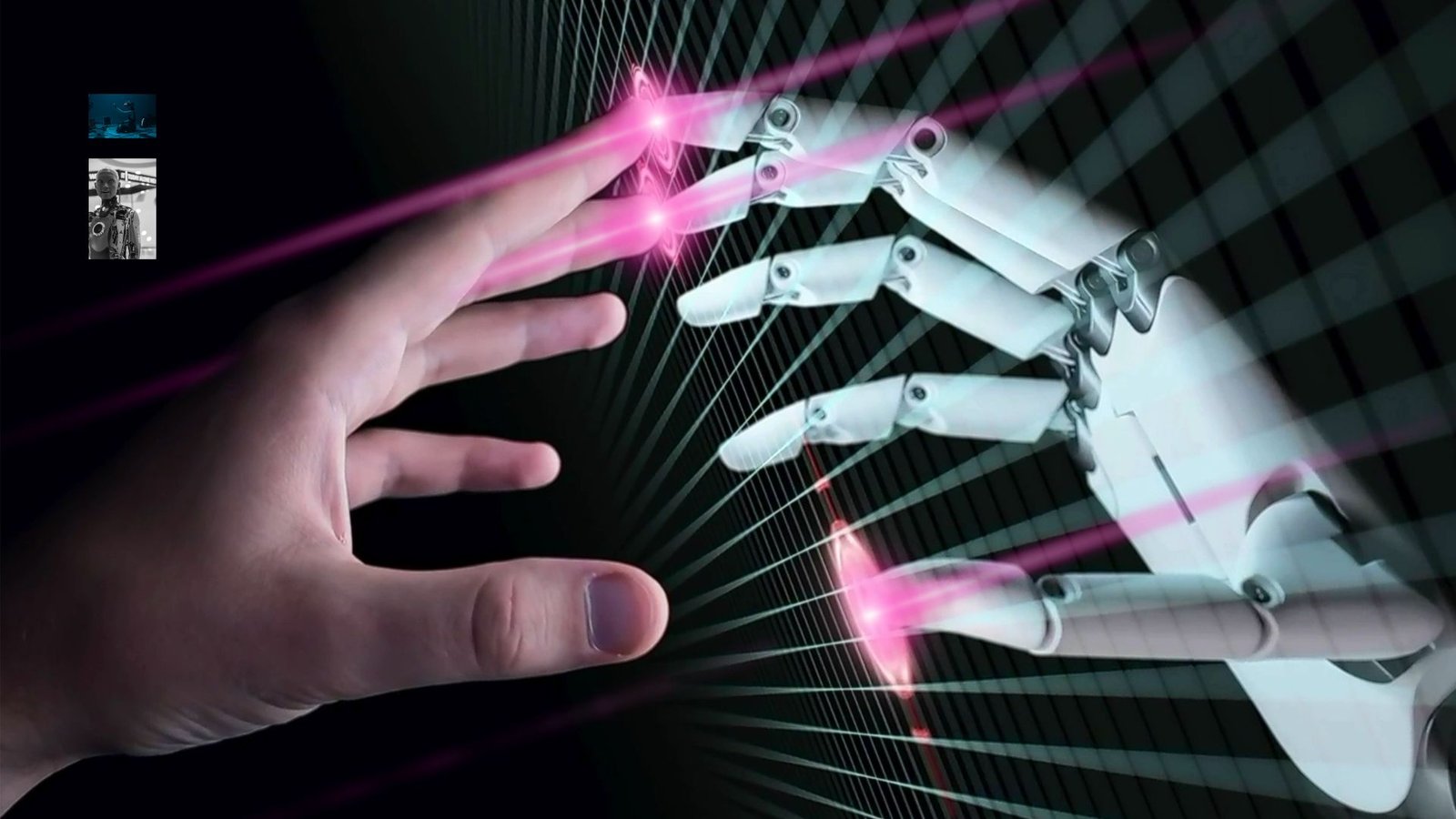
The Symphony of Autonomous Minds: How the Convergence of Robotics, AI, and Future Tech Democratizes Global Human Potential
An exploration into Embodied AI, physical machine kinematics, spatial computing architectures, and their direct pipeline to breaking educational barriers in under-connected environments.
I. The Convergence Horizon
Throughout the computational era, humans have treated intelligence and action as disparate paradigms. Code resided within silicon microprocessors, whereas mechanical movement lived in industrial machinery constrained by strict, deterministic kinematics. However, as we pass the threshold of 2026, we are witnessing a profound structural convergence: the unification of generative artificial intelligence and high-fidelity mechanical systems.
This is not merely the development of more versatile robots. It is the emergence of Embodied Cognition—the physical manifestation of deep neural networks capable of sensing, processing, and dynamically impacting their surrounding realities in real time. For premium platforms like VEO.co.in, understanding this convergence is critical because it fundamentally alters how global education is structured, distributed, and accessed.
“The primary bottleneck of human society has never been a shortage of information; it has been the density and accessibility of personalized guidance. By packaging generative neural intelligence into localized, physical autonomous nodes, we close this accessibility circle.”
— VEO Advisory Board on Frontier Systems
II. Embodied Intelligence & Kinematics
Traditional robots operate on basic geometric trajectory equations. If an obstacle deviates by even a single millimeter from the mapped path, the process fails. Embodied AI overcomes this constraint by embedding high-level deep transformer models directly into the feedback loops of mechanical control modules.
Using modern high-speed sensors, localized robot units map their immediate spatial environments via real-time Neural Radiance Fields (NeRFs) and 3D Gaussian Splatting. Rather than processing raw video arrays in expensive cloud nodes, advanced on-device processors use efficient video streaming pipelines, compressing visual data before relaying it across localized edge networks. This compression is governed by the structural data efficiency equation:
Where $ \eta_{\text{edge}} $ represents the overall local efficiency, $ C_{\text{local}} $ is local compute capacity, $ H_{\text{sensory}} $ is sensory density, $ B_{\text{network}} $ represents active cellular network bandwidth, and $ \Phi_{\text{latency}} $ is processing system delay.
Through this optimized balance, a machine can continuously calculate micro-adjustments in its motor actuators. The mechanical feedback loop is no longer programmed; it is learned through continuous training in highly accurate synthetic physical simulators.
[MIT Robotics ’25]
“Embodied Pathing via Edge Transformers”
MIT Lab Report, August 2025: Documenting real-time feedback reductions below 2.4 milliseconds.
III. The Cognitive Core: Spatial Intelligence & Generative AI
What separates modern robotics from historical systems is the introduction of Spatial Intelligence. Traditional AI models are highly adept at processing words and flat arrays of pixel values. However, spatial intelligence models understand objects in context: their mass, friction limits, material compliance, and dynamic physical interactions.
Spatial Navigation Pipelines
Continuous 3D semantic mapping allows mechanical systems to comprehend spatial voids, calculate object vectors, and operate securely in dynamic environments alongside humans.
Edge Inference Architectures
By leveraging optimized local parameters (e.g., INT4 quantization), modern robotics run highly complex neural networks directly on cost-effective, low-power edge microcontrollers.
When applied to educational and societal structures, spatial intelligence empowers physical teaching aids. Rather than a flat, interactive screen, a student can work with an active mechanical physical system that demonstrates mechanics, structures, chemistry, and aerodynamics dynamically. This changes learning from passive video streaming into active, hands-on mechanical experimentations.
IV. Socio-Educational Democratization
The mission of VEO.co.in is rooted in bridging technical engineering pipelines with global socio-educational reach. Advanced technologies—whether artificial intelligence, modern video codecs like H.266, or robotics—often remain restricted to well-funded academic settings. We argue that the ultimate value of Embodied AI lies in its potential to democratize access to high-quality education.
In remote regions where human educators face limited connectivity and resource shortages, localized physical systems can act as reliable educational support nodes. By utilizing highly optimized local translation models, these nodes can instantly translate advanced technical content into localized regional dialects. They act as on-demand, interactive tutors, bridging gaps where access to skilled local instructors remains constrained.
Furthermore, these systems do not require high-speed fiber internet. By utilizing ultra-efficient local compression and edge-based storage networks, educational modules can be distributed across local village hubs via peer-to-peer configurations, operating independently of constant cloud connectivity.
Robotic Socio-Ed Deployment Estimator (R-SEDC)
Simulate the cost-efficiency of deploying edge-enabled robotics to rural educational nodes. Adjust parameters to balance hardware volume, on-board computation, and software configurations.
$402.50
Estimated hardware production and testing expense per node.
1.2M Students
Projected student reach across connected centers.
Mathematical Cost Model Formulation:
$$ U_{\text{cost}} = \left[ \frac{H_{0}}{\log_{10}(V)} \cdot C \right] \times \left( 1 + S_{\text{markup}} \right) $$
Where $ H_{0} = \$1100 $ base unit cost, $ V $ is volume, $ C $ is compute multiplier factor, and $ S_{\text{markup}} $ is proprietary markup.
VI. The Ethical Frontier and Coexistence
Any technological paradigm shift inevitably presents novel ethical and societal questions. The integration of Embodied AI and advanced robotic networks is no exception. As these systems become more active in physical learning and community environments, we must carefully evaluate their impact on human-to-human relationships, labor dynamics, and data privacy.
Key considerations include:
-
1
Preserving Human Interaction: While robotic aids offer valuable educational and mechanical support, they should enhance—not replace—human instruction. Deep learning systems are tools, not a substitute for the empathy and mentorship of a dedicated human educator.
-
2
Protecting Student Privacy: Localized sensory nodes capture substantial physical, vocal, and behavioral data. Strong localized encryption algorithms must ensure student metrics remain secure, unshared, and strictly confined to on-device hardware.
-
3
Promoting Open Standards: Preventing proprietary software lock-ins is essential. Deploying open-source robotics hardware guarantees that communities worldwide can maintain, modify, and upgrade these systems cost-effectively.
These ethical principles are vital to our mission at VEO. Navigating the transition from passive screen interfaces to physical human-machine coexistence will shape the trajectory of education for generations to come.
Join the VEO Academic Network
Get bi-weekly technical briefs on AI, advanced mechanical systems, and real-world socio-educational engineering reports.
